Radical change can seem small when seen up close. I was deep in the weeds, reading again about Mr. George Starkey, a doctor and alchemist living in London in the 1650s. Starkey's life has been a subject of some study by historians of science precisely because a lot of his work survives. We have his numerous published works, those of his contemporaries, and his especially valuable private work diaries.
It was in the passages of one of these diaries that Dr. Lawrence Principe and Dr. William Newman puzzled through precisely how Starkey and his collaborators (Newton, Boyle, and Van Helmont) formulated and practiced what would become the modern scientific method. Starkey, for example, records his experiments in a traditional Scholastic style. In those days schools taught using a method derived originally from Roman jurisprudence later adopted for use in theology: the disputation. There were multiple kinds of disputation, but in each two people debated the merits of a question or quaestio. The important change: Starkey's opponent is Nature herself. He worked with his alchemical furnace to burn, boil, and distill the essence of matter. Hence where Starkey's experiments fail he writes that his question has been refuted by the fire.
[Starkey] actually carried his Scholastic education into the laboratory and used it there. At the same time he augmented the standard divisions of argument with new categories more appropriate to his practical experimentation, such as his "Observations," "Conjectural Conclusions," "Notables," and "Hands-On Trials."
Newman & Principe, pg 171.
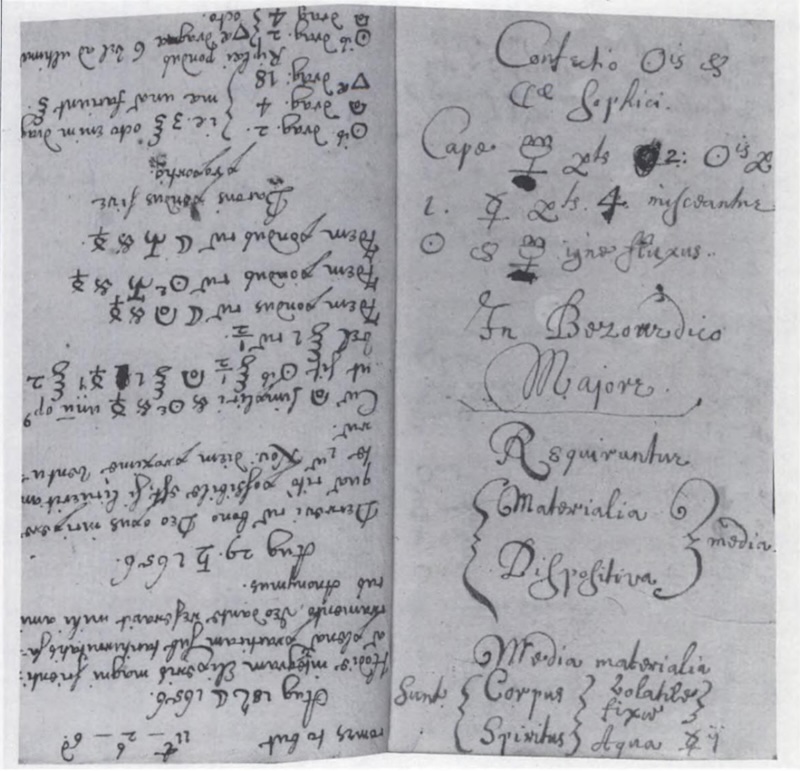
by William R. Newman, Lawrence M. Principe
This divergence into Starkey's methods led me straight to the form and function of medieval Scholastic learning which was heavily theological, legal, and philosophical. The Scholastics held firm to the philosopher's maxim: When in doubt, draw a distinction,
and we see Starkey do precisely this on several occasions.
This left me with a questio of my own: when did the disputation die off? Was that somehow tied up with the methods of science Starkey and others were developing?
This is the usual form of my research, and the dual blessing and curse of reading non-fiction. It raises questions, then provides footnotes as enticing breadcrumbs to follow to the answer.
That lead me to Brian Lawn's work on The Rise and Decline of the Scholastic Quaestio Disputata, a dense if interesting read on how precisely the disputation arose in post-Roman Europe as the pinnacle of scholarship, thrived in the middle ages, and died out in the early nineteenth century. In it, Lawn also digs into the work of William of Occam, including his famous razor and includes a fascinating discussion of Nicole Oresme who was one of the first scholars to attempt to quantify motion (more on that another time). Over time the disputation became increasingly formalized, written down, and became a requirement for those seeking the degree of Master at university. Our old friend Starkey did one at Harvard (now lost).
A new question arose:
Masters don't do disputations anymore; they write theses. When did that change? And what about Ph.Ds? They write dissertations. Are they related to disputations? Both sometimes involve an oral thesis defence. Is that a clue?
A cursory investigation told me that the modern Ph.D. arose in the mid-nineteenth century. That timing is a bit suspicious, isn't it?
Unfortunately here is where the footnote trail starts to run thin. In 1981, Thomas Malone published his doctoral thesis which seemed to be my best lead. Thankfully, you can get almost any book you want if you really try.
Malone's work is interesting and covers the history of how American Universities at the dawn of the twentieth century were modernized and new schools were formed following the model of German research universities like Göettingen. Relying heavily on the work of Charles McClelland, Malone describes how these schools emerged from the reforms of the late eighteenth century which transformed the role of the schools and their professor-class into the teaching-research hybrid we see today. Before that time, universities and professors were repositories and collectors of knowledge, not the elicitors of new knowledge.

A.Savin, FAL, via Wikimedia Commons
If German universities were the source of this change, then it'd be there where I would find the answers to my questions. Unfortunately McClelland's work is too broadly scoped to answer my specific question and Malone's work is scoped to the impact of the Ph.D. in the United States. However there was one clue hidden in the conclusion of Malone's work.
A study of the history of the Ph.D. degree in Germany and the accompanying [dissertation] would provide more background for the Ph.D. dissertation in the United States. Such a study would necessitate visits to the German universities such as Göttingen and Halle. Supposedly the libraries and archives of German universities would yield an accurate account of the development of the Ph.D. dissertation in Germany. Such a study would be significant because the Ph.D. degree and the [dissertation] are, to a large extent, taken from the German university.
Thomas Malone, pg 153.
A part of me wants this connection to be true, in part because I like traditions. I like to know that our present is connected to the past and while it seems that the modern dissertation is indeed related to the medieval disputation in that it arose while the other died out, the precise nature of that connection is still unclear to me. We know that the Ph.D. dissertation (and the master's thesis to a similar extent) was formulated right as the disputation died away. Universities across the western world phased out the latter right as the former came into being in the time between 1820 and 1860. From there the trail goes cold. I tried to dig in further, following footnotes as I am wont to do, but McClelland's sources are all in German. I'm not above learning a little of a language for this work (I did learn a bit of Latin a few years ago), nor am I above screenshotting a dozen pages to throw into Google Translate, but this task is simply too big for me to tackle.
Little research has been done in this area since 1981, much to my surprise, and so it seems that we simply do not know how and where the disputation died and was replaced by the dissertation. We do not know if the modern thesis defence is a medieval tradition carried into the modern day. I suspect as much, but cannot say. We simply will not know until someone goes to Göttingen to find out.
Errata: Along with this post, I am debuting an AI usage policy for this blog. It's in the sidebar for future reference.
Have thoughts? Shoot me an email.