There is a difference between knowing something, and truly understanding it. I think we've all had those moments, the ones where a truth you learned a long time ago really sits with you for the first time. It rests in your mind and stretches out, finally showing off the great expanse of nuance hidden deep within.

Most nights when you happen to spy the Moon, Jupiter, and Venus sitting in a line in the sky, you see them as the dots beside a crescent that they are. Yet sometimes, when framed amid the sunset sky above the wisps of silver cloud, you see them differently. You realize in that moment that you, your great-grandparents, Julius Caesar, and Aristotle all saw this same sky. It has always been for us. We know so much about Jupiter and Venus today, yet no human eye has ever seen more than you're seeing now.
I think we are all, in this time, realizing the true power of words and what they mean, not to those who speak, but to those who listen.
The Power of Stories
It was Eugene Wigner who famously wrote about the unreasonable effectiveness of mathematics in the Natural Sciences, the empirical fact that advanced math is eerily accurate at predicting the behavior of nature, so much so that, for me, it can seem like mathematics is perhaps the true language that nature speaks.
However, as children, we do not grow up with an innate understanding of complex mathematics, of this foundational language of nature. Instead we are all born with the innate desire to hear and to tell stories, of ourselves, of others, and of the world around us. Our well-known cognitive biases push us to accept stories that rhyme over those that do not, and believe the people we speak to. That last one is particularly important in this age because there are simply so many words out there ready to be believed.
Stories are how we share information and how we've warned, cast out, and praised each other for millenia. We tell stories, to ourselves and to others, about why we are successful (or not) and why others might be (or not). We moralize disease, in part perhaps because a moral story is easier to bear than the sheer randomness of a chaotic world. Our minds work to make sense of the world by finding patterns. As those patterns interweave and become cohesive narratives, a story emerges to explain the where and why. These stories are so critical to our understanding of the world that we hold on to them, make them part of our selves, and when they break down they can break the self too. In the end, all we have of the world and the only truth we know first-hand, are the stories we tell ourselves.
We communicate those stories, to ourselves and to others, with gestures, actions, and most importantly with words. That makes those words perhaps the most powerful force in human society. They are the fundamental interaction that holds our world together. It's the words from the past that we reach for as some justification or authority. It's words of the famous and the clever that we laud or reject. Even Mathematics, this jewel of the modern world, is communicated and taught in words. To our storied minds, these atoms of thought are everything.

via Wikimedia Commons
Disinformation and misinformation have been rampant in the past, but never before has there been a world filled so chaotically with so many clamoring voices. The Ancient Greeks warned of Sirens and their terrible, entrancing songs, yet today sirens sound in our ears and on our eyes every moment of every single day.
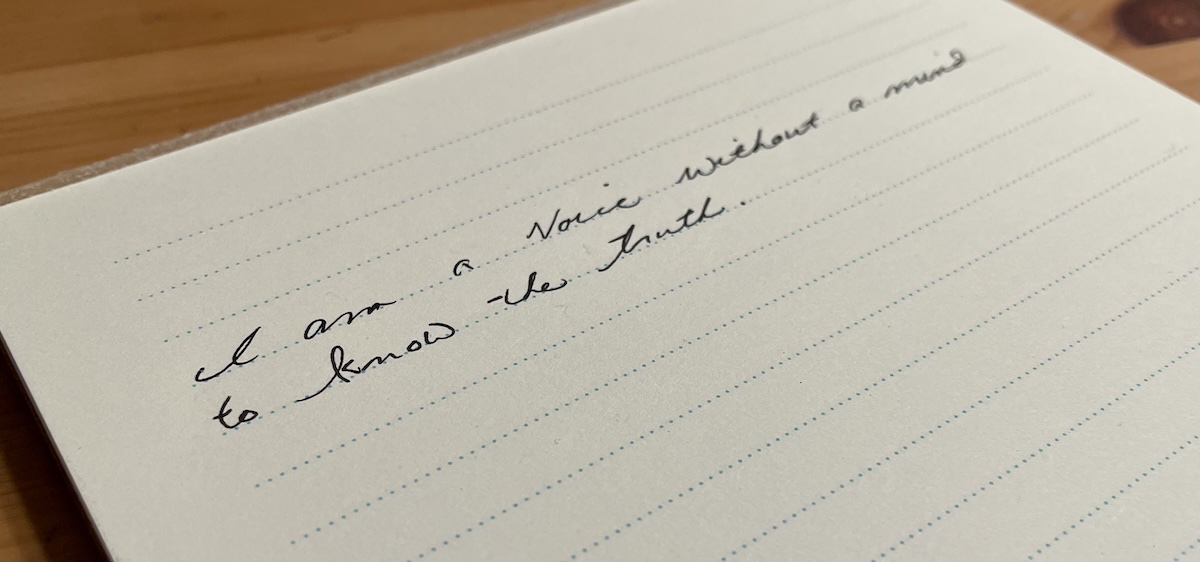
However today, we have also come into a new thing, a step function in our communication. In this time we humans are not the only one who is talking. This is not because we are some perfect specimen of wordcraft, or that another species could not do what we do, but because our chosen, crafted interlocutor is not a mind like ours. It is a device which has no notion of truth or of morality. It is a parrot, who imitates our speech but does not understand it. It does not learn, and it cannot. Yet we still can, and we will learn what it tells us, regardless of its truth.
Words Without a Mind
Support Vector Machines (SVMs) are a type of machine learning algorithm that have been around a long time. Random Forests are another. Both are very good at sifting through swaths of noise looking for the signal. SVMs and Random Forests help identify disease incidence in large populations, and find novel ways to identify genetic causes of complex conditions. Techniques like these were spreading in academia and industry a decade ago. I remember when Apple released a drag-and-drop app to help developers build simple models for recommendation systems! This stuff has been around for a long time.
Yet, if that's true, why did it take Large Language Models (LLMs) to break into mainstream consciousness? People had been hammering on the idea of rebranding Machine Learning as Artificial Intelligence for years, but these days LLMs are synonymous with AI while other techniques aren't. True, modern LLMs are impressive technically, but is that the reason? Or is the reason totally distinct from technology? Perhaps we call LLMs intelligent, perhaps we adopted them in a frenetic rush, and perhaps we fear them most not because they are particularly good machine learning algorithms, but because, at long last, they do not speak in vectors or in numbers, but because they speak in words and words are our domain.
via Wikimedia Commons
I think back to a cognitive bias I listed above: that we tend to believe the people we are speaking to. No other machine learning technique, no other AI, has ever spoken to us, sounded so much like another mind. At every opportunity when technology has enabled new forms of communication: books, pamphlets, letters, emails, instant messenger, text messaging, we have always used those tools to seek out others like ourselves and to share and listen to new stories. Those stories used to correlate roughly with some level of truth about the world, if even about a single interpretation of it. Now we have language statistically built to sound genuine, and yet its speaker has no mind or experience to convey. Still, we believe so deeply in the power of words that many of us have preferred this plausible-sounding make-believe to reality.
Left Wanting
There is evidence that perhaps LLMs, unlike social media, will help push us to the center—to the statistical average—and if LLMs were somehow guaranteed to only be trained on human-generated data forever, perhaps this would be true. However as we further diverge the words we see from any objective meaning, both in human communication and in the words written by our new AI chatbots, this situation will not be stable for long.
Ultimately though, what's important is not that we have built tools to generate digital text. What is important is that, like processed food and sugar, our long-ingrained biological need to share and hear stories is being hijacked and used by technology. Ascribe whatever values to that you wish, the morality is not my point. Humans have looked out at the stars and wondered why: why we live and die, and whether this universe was made for us, and whether we belong within it for millenia. Those questions remain, save now we have the ability to trust in a voice that tells us precisely what we want to hear. We filled a caloric need with cheap candy, shelf-stable cupcakes, and soda. These are convenient things, good in moderation, but still they can hurt us and we're still struggling to solve the problems they created. Today we may be filling an emotional need as well, functioning as the scheming court vizier that whispers sweet and comfortable truths. Yet unlike the stereotype, this vizier does not scheme. It has no mind and no goal save to please, yet we wish so deeply to be pleased.
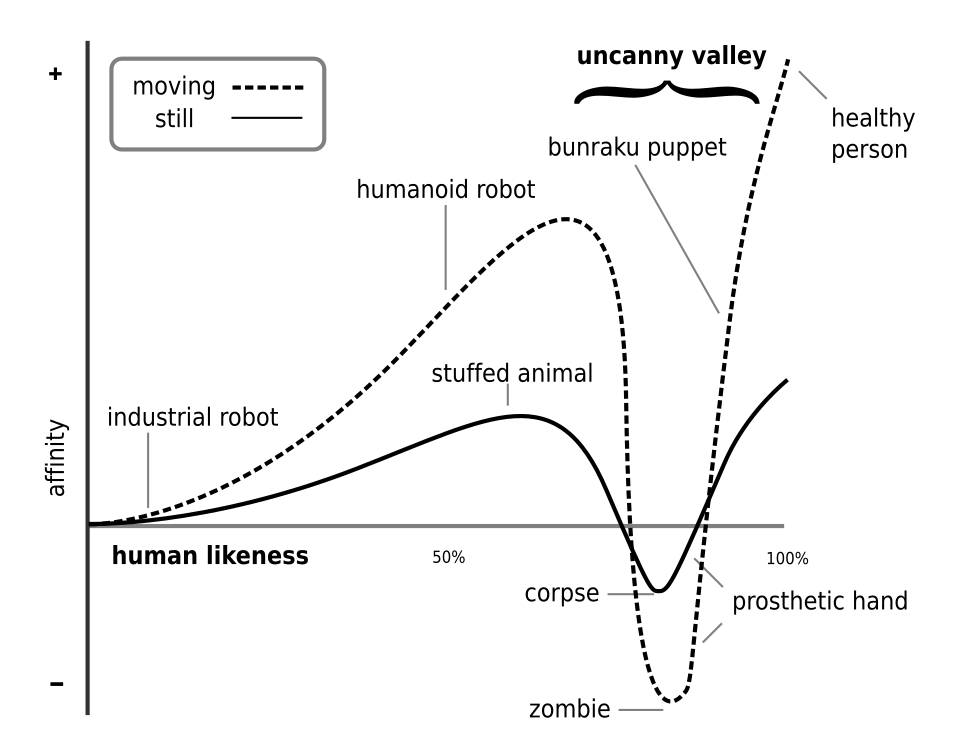
Masahiro Mori and Karl MacDorman
This need comes deeply ingrained in us and will be impossible to fill. It is part of the Human Condition. Perhaps, given time, this new kind of statistically-driven language will find itself deep within the unforgiving well of the Uncanny Valley. We shall see. No doubt the Sirens seemed convincing for a time. As a gas-station pastry is no substitute for a good and hearty meal, the words of prediction engines are but vain and fickle things, lovely in the ear perhaps but hardly satisfying to the soul.
For millenia words have been a proxy for connection with another mind, today that link is severed but the need in us remains and there is only so long that one can fill a void with empty calories. We retain our position as the only being in the Universe who can tell their own stories and who can be said to learn and share the truth. The Font of Knowledge still begins and ends with us and The Odessy of Finding Truth is a lonely one, cast as we are amid the stormy waters of the world, even as there are many clamorous, seductive voices calling to us from the distant shore.