What makes a person successful in life? People credit fame, money, family, effort, and random chance. Certainly all of these play some part. But how much should we credit each of these on a person-by-person basis? Perhaps a better question might be, can we get an intuition for what it means to be successful in these ways? Not for how success feels, but for how the chaotic system of success in the real world behaves?
I'm not sure, but we can try.
I love physical analogues for complex topics, even if they're slightly wrong. I find analogues useful because they can make a tricky concept easier to grasp and they can occasionally surface novel intuitions. As Grant from 3Blue1Brown explained when talking about Maxwell's equations:
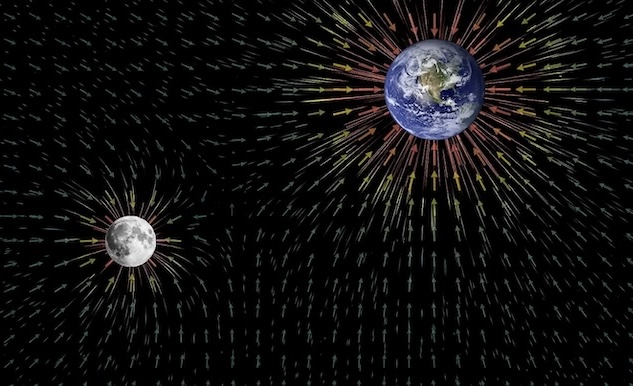
An important idea which regularly goes unsaid is that you can often understand a vector field which represents one physical phenomenon better by imagining:
What if it represented a different physical phenomenon?What if [vectors] representing gravitational force instead defined a fluid flow?
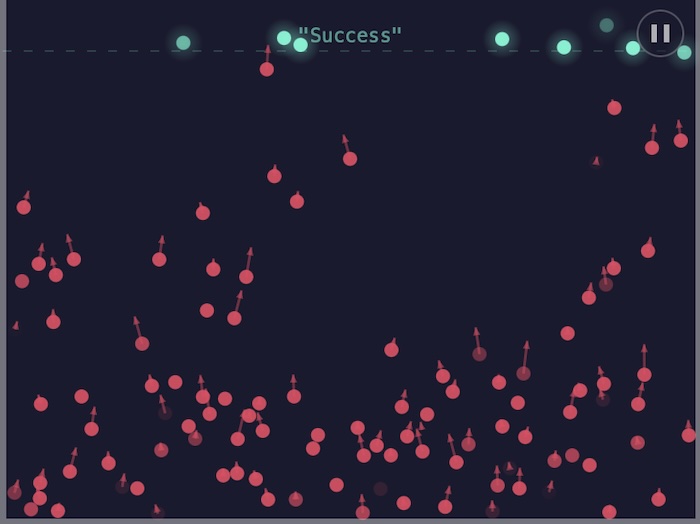
In that spirit, let's try to make a physical simulation of how one can think about success. If we simplify and say that, whatever success is, more of it is better we can model success as being a simple value on a 2-D axis. The higher up
on the chart one goes, the more successful they are. Let's call some point near the top of the chart Successful and assume that once you become successful you stay that way (or die). Everyone wants to be successful to varying degrees and that want changes over time, so we should give each individual in our simulation some randomized inclination to do so (some innate force) that pulls them upward. Now, not all people imagine success the same way and so we can make the vectors wobble left and right to track an individual's changing picture of their path to success. Next, we can model the various forces of the world which drain one's resources and time away from this goal as a sort of gravity
pulling them down.
Likewise in a social world, it's impossible to become successful at anything significant without other people's help, so we can assume that people can influence each other (helping and hurting), and that doing so expends some of their own energy too. This last assumption is pretty suspect, but it allows us to model person-to-person interactions as simple elastic collisions (i.e. like billiard balls) which is incredibly convenient.
Finally, since life is short, we'll assign a counter to each ball that times out after a certain random period. Once it does, the ball fades from view and a new ball spawns at a random position on the board.
individualis
tryingto succeed.
What we have then is a sort of sloped billiard table model of success in which balls compete to get to the end but compete against gravity and each other to do so. Some people, as you can see by watching the simulation, make it by sheer dumb luck: being born at the right place and time. Others rely entirely on who they know (i.e. who they interacted with), while most never make it to their goal. Some get tantalizingly close before getting knocked down by a chance encounter and others strive all their lives to die out too close to the end.
It's a (somewhat) silly and ultimately zero-sum model of the world, one that is wrong on several levels, but building it in the first place is what allowed me to more concretely see what assumptions I was otherwise implicitly making.
Expect more like this here in the future because building models of the world is fun, and it's a great way to think through the increasingly complex problems of our age.
Have thoughts? Shoot me an email.