Yesterday I stumbled on this quote from a blog post by JA Westenberg:
Michel de Montaigne arguably invented the essay in the 1570s, sitting in a tower in his French château, writing about whatever interested him: cannibals, thumbs, the education of children, how to talk to people who are dying. He called these writings essais, meaning "attempts" or "tries." The form was explicitly provisional. Montaigne was trying out ideas, seeing where they led, acknowledging uncertainty as a fundamental feature rather than a bug to be eliminated.
It's hard to convey the sense of both profound agreement and giddy joy I had reading that because, not only is the wider post about something I love (i.e. blogging), or because I learned something new about the history of writing (which is always fun), but because that quote describes something that I've been doing myself for the past two years and wanted an excuse to talk about!
What Writing Is
There's an old adage that says, "Writing is Thinking" and I've usually interpreted those words to mean that "writing helps you think", which is undoubtably true. However in recent years I've discovered an entirely new form of writing that I've taken to calling: musing, that I think takes this idea a step further, and it's precisely what Westenberg describes Montaigne doing in the 16th century.
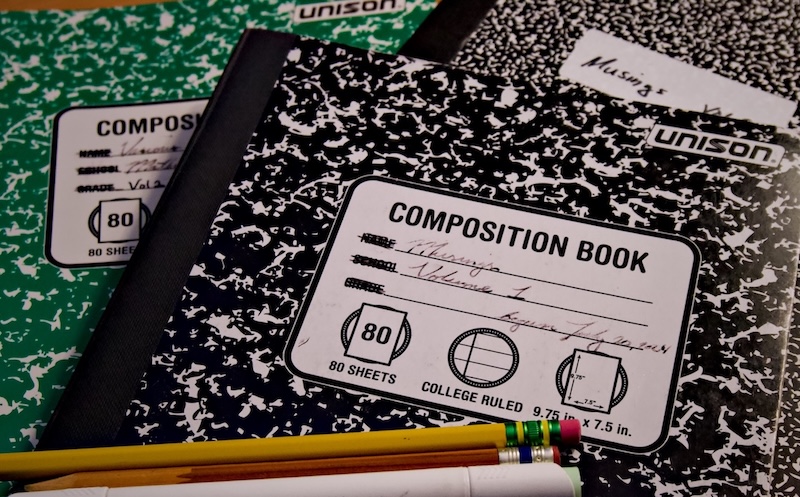
We have a lot of thoughts throughout the day, and yet we spend so little time indulging these idle curiosities. Writing, especially by hand, can be a great way to explore these ideas and to practice thinking. It's also really fun to do! Over time I started collecting these ideas into notebooks (one of which I almost always carry with me) in order to better organize these inherently random topics into a searchable system. Originally I scribbled on loose leaf pages or random legal pads (as I've mentioned before) and that became unruly very quickly.
Some of these musings are personal topics, most are not. Often they're just the exploration of a question I have. Here's an example:
Businesses keep offices cold because there's research saying that cooler temperatures help people think and stay focused. Given that's true, could the Little Ice Age have helped improve human cognition during the 17th and 18th centuries? If so, what does that mean?
I'm not sure, but it was something I thought about for a while and so I wrote it down. The entire musing, or essay as I guess it should be called, is less than a page, but was engaging and very fun to do. I've written short essays about dozens of topics over the years (including several that have been eventually published to this blog). It's a fun practice, and I encourage you to try it.
More Musing Ideas
- Why am I feeling sad lately?
- Why do we see sunsets as beautiful?
- Second-guessing [prior topic]
- What function does the press fulfill in society?
- Why is that valuable?
- How could that value be measured?
- What is the single, smallest change I could make to the U.S. constitution to have the biggest impact on the problems I see?
-
Do stories follow mathematical laws?
- What would that mean for us?
- How could such a thing be measured?
- How come we seem to intuit these laws?
- What is math?
- Is [current stress point] a long-term problem or a temporary one?
- What is the cognitive purpose of stereotypes?
- What would it feel like to live 10,000 years ago?
- Let's try to comprehend the fullness of human history!
- I had an idea for a cool—but probably useless—invention!
Explore your ideas honestly. Don't fear where your mind goes or the questions it will ask. These are personal, honest thoughts not social media posts. Writing like this is inherently introspective, it's a way to give your mind the space to awe and wonder
What Thinking Is
We often believe that thinking is a process which takes place entirely in the mind, but it's a process that is heavily influenced by the particulars of the body. Try thinking through a problem in a hot and smelly room or on a walk with a rock in your shoe.
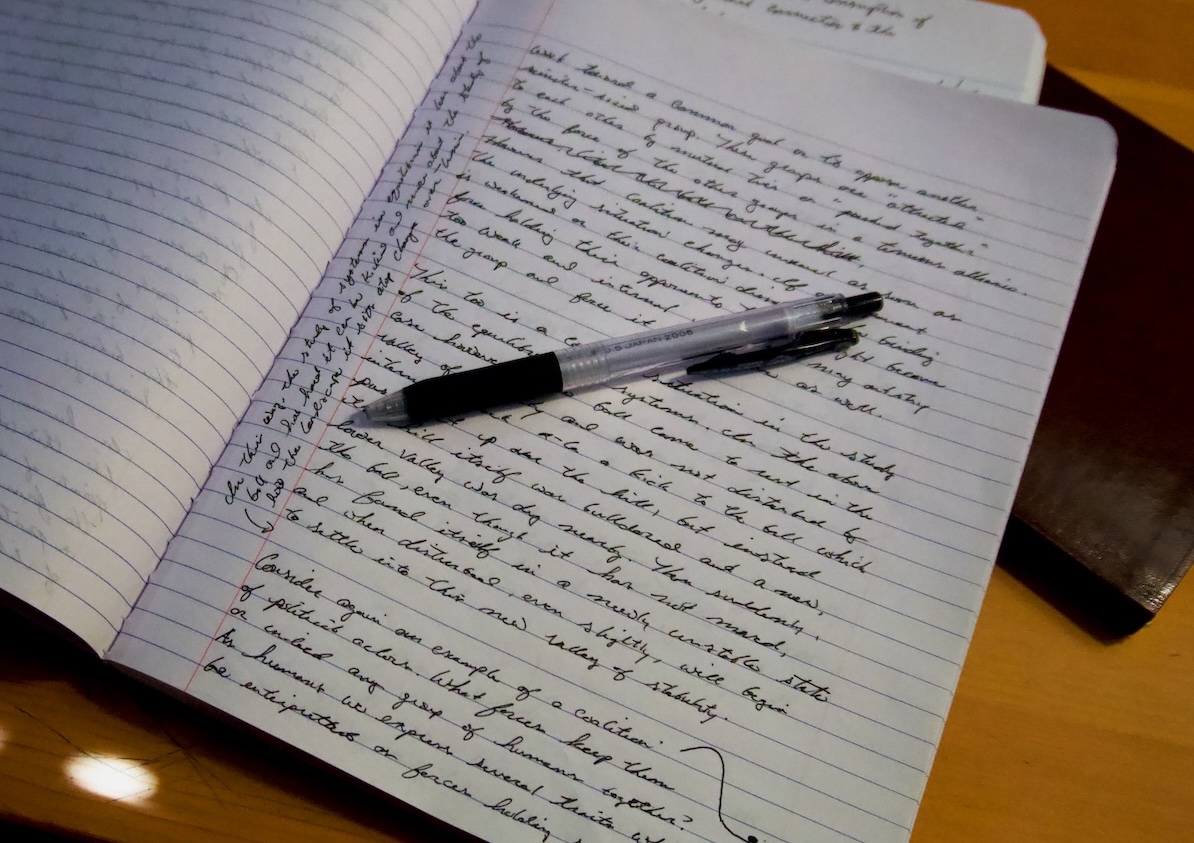
However, the body can do more than hinder the thought process, it can catalyze it! This is what writing can be, a way to think through problems using your entire body.
Occasionally, I've sat down to write but without any particular topic in mind. So, I open my notebook and just start writing. Tons of my essays begin with something like, "I'm not sure what I'm thinking right now and I don't know what to write." From there, I let my thoughts move and course as they will and I just write down what comes to mind, stopping and starting as my thoughts shift and change and eventually I will find that something has come out of it. I might work through a tension or stress point, I could come to realize or discover something about a problem, or I could just get a few lackluster thoughts on a page. Not all thinking is productive but the mind is a muscle and it needs to be exercised to function properly. Sometimes just doing the workout is enough.
Thinking as a Skill
We usually think of cleverness or intelligence as an innate trait people have, and while that is certainly true in some regards, intelligence and wisdom are just as much a function of practice as of talent. To get good at solving puzzles, you have to practice solving puzzles. The mind is no different than a muscle in that regard. Thinking aloud on the page is one way to record and analyze your thought process and to practice the art of thinking itself.
As another example, I often revisit my prior writings and find many to be overly simplistic, uninspired, or just plain wrong. But that's good! It means I've learned something in the intervening time! In software there's an addage:
If you come back to old code and see nothing wrong with it, then you haven't learned anything since.
You are not a finished product, you're a process—always in motion—that evolves and changes over time. Your thinking can improve with practice as much as it can atrophy from inattention.
Think about thinking, write those thoughts down, then perhaps publish a few on a blog that you own. It's fun, and it can do wonders for the mind.